
Green Star® Has Changed: Three Takeaways Manufacturers & Suppliers Should Act on Now
HIGHLIGHTS of September 1 Webinar Briefing ...
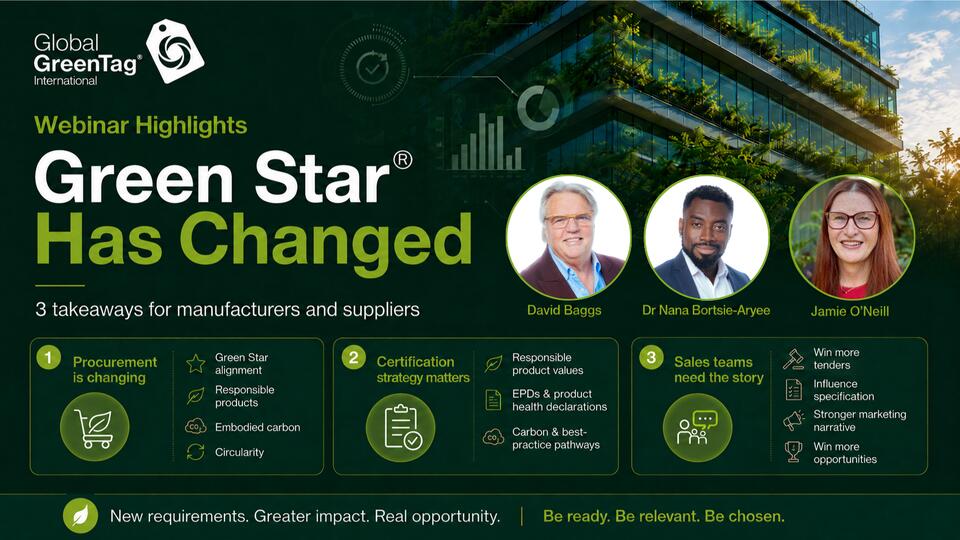
Global GreenTag International's first Manufacturers Roundtable Briefing explored how changes to Green Star® and the Responsible Products Framework are beginning to influence product specification, procurement and purchasing — and what manufacturers and suppliers can do to prepare.
Global GreenTag International brought manufacturers and suppliers together on 1 September 2026 for its first Manufacturers Roundtable Briefing: Green Star® Has Changed. Is Your Product Portfolio Ready?
Presented by Global GreenTag CEO, Technical Director and Cofounder David Baggs, Program Director Dr Nana Bortsie-Aryee, and Global Sales & Business Development Manager Jamie O'Neill, the session examined changes to Green Star, the Responsible Products Framework and the growing role that independently verified product information is playing in projects seeking Green Star ratings.
For product manufacturers and suppliers, three messages stood out.
1. Green Star requirements are moving from policy into real-world procurement
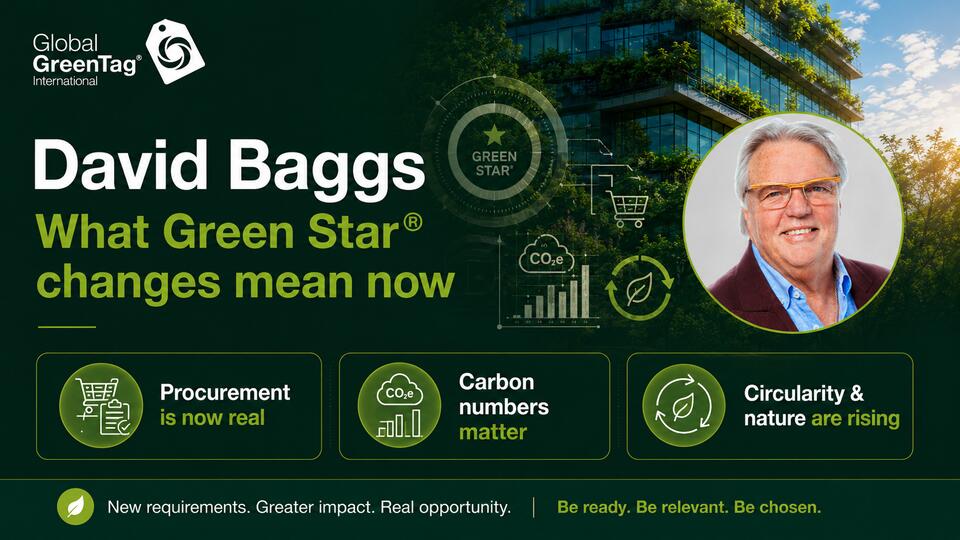
Perhaps the most important message from the webinar was that the changes are no longer something manufacturers should regard as being "down the track".
The Responsible Products Framework introduces recognition of product certification schemes and assigns Responsible Product Value (RPV) points to recognised initiatives. Certified products can also be included within the Green Building Council of Australia's pre-qualified green products database.
David Baggs explained that Green Star Buildings projects registered since 2025 are now beginning to move through to procurement. That means manufacturers are increasingly likely to encounter these requirements through specifications, tenders and purchasing decisions rather than simply through sustainability policy documents.
The shift is particularly significant in relation to embodied carbon. Under the requirements presented during the webinar, five-star Green Star Buildings projects in 2026 are required to achieve a 20% reduction in upfront carbon, while six-star projects are required to achieve a 40% reduction. The evidence needed by project teams increasingly comes back to product-level information such as Environmental Product Declarations and product carbon footprints.
This changes the conversation for manufacturers. Having an EPD can help establish that credible environmental data exists, but increasingly the performance data within that EPD matters too.
As David explained, products are beginning to be judged not simply on whether an EPD exists, but on the carbon numbers it contains.
Circularity is also moving more firmly into the Green Star framework. The new Fitouts tool places greater emphasis on issues including modularity, design for disassembly, repairability, products-as-a-service and measurable product circularity.
What manufacturers can do now
Review the environmental data available for each major product range. Manufacturers should be asking whether they can provide project teams with credible, readily accessible evidence covering life-cycle impacts, upfront carbon, circularity, material health and recognised third-party certification.
The question is increasingly moving from: "Do we have a sustainability credential?" to "What does our verified product performance demonstrate?"
________________________________________
2. Responsible Product Values have changed — and the right combination of certifications can matter
 :
:
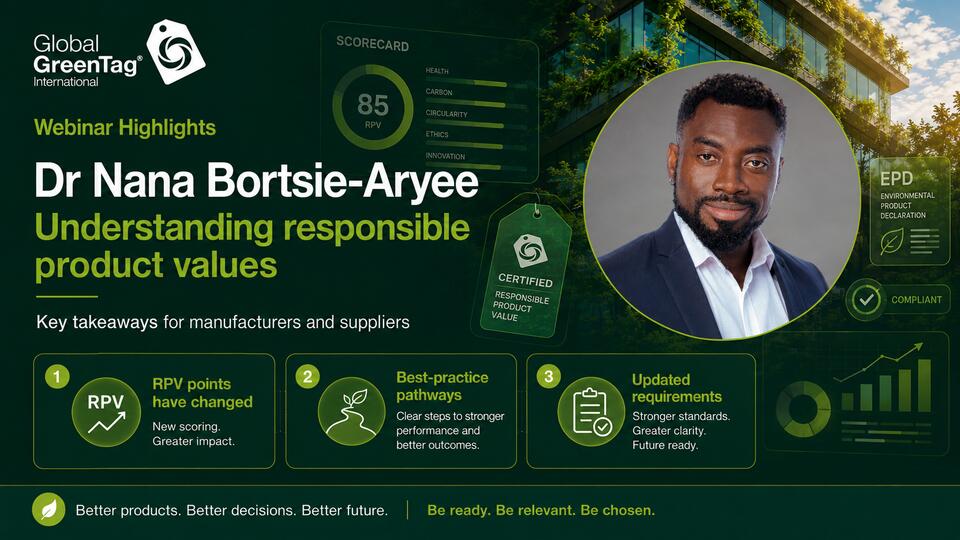
Dr Nana Bortsie-Aryee provided manufacturers with a practical look at how Global GreenTag certifications now sit within the Responsible Products Framework following recent evaluations with the GBCA.
He explained that Responsible Product Value points for several GreenTag certifications have changed significantly. GreenRate™ Levels A and B can now achieve 12 RPV points, while Level C can achieve 11, LCARate™ achieves 17 points, CarbonRate™ now attracts three points, and the Product Health Declaration (GreenTag PHD™) and HealthRATE™ remains at 10 points and EPDs earn 7 points.
Importantly, Nana explained that manufacturers need to consider not only how many points an individual certification provides, but whether the combination of recognised initiatives held by a product enables it to reach Credit Achievement (Good Practice) or Exceptional Performance (Best Practice) within the relevant Green Star category.
For example, a certification that on its own reaches good-practice recognition may potentially be combined with an EPD or another recognised initiative to help a product reach a higher threshold.
That creates a different strategic question for manufacturers:
Is your product carrying the most effective combination of independently verified credentials for the markets in which you want it specified?
Global GreenTag is also updating aspects of its certification requirements in response to the evolving Responsible Products Framework. Nana highlighted changes including mandatory publicly available chemical disclosure information, a modern slavery policy requirement, expanded VOC requirements for relevant interior products and clarification of EPD requirements associated with LCARate™. Transition arrangements are being considered as these changes are implemented.
What manufacturers can do now
Rather than looking at each certification independently, manufacturers should review their entire product certification portfolio.
For each important product, ask:
- What Responsible Product Value does it currently provide?
- Does it reach Credit Achievement (Good Practice) or Exceptional Performance (Best Practice) or, another relevant Green Star threshold?
- Does the product still meet the latest certification requirements?
- Is all supporting documentation current and readily available?
This is increasingly a product portfolio strategy, not simply a certification exercise.
________________________________________
3. Certification is becoming a sales issue — and manufacturers should involve their commercial teams
 :
:
Jamie O'Neill brought the discussion directly back to commercial outcomes.
Her message to manufacturers was straightforward: businesses should investigate whether the absence of certification — or allowing certification to lapse — is already costing them specifications, tenders and sales.
O'Neill encouraged manufacturers to speak directly with their sales and account teams and ask whether projects have ever been lost because required certifications, EPDs or environmental credentials were missing. She also recommended benchmarking competitors: what environmental credentials do competing products carry, and are those competitors consistently appearing on projects where your products are not?
During the presentation, she referred to recent feedback received from manufacturers that had lost bid opportunities because they were unable to provide certification required by a project. Conversely, certified manufacturers had reported success in using their credentials to support tenders, repeat business, marketing and product positioning.
Maintaining certification is equally important. O'Neill noted that manufacturers can find themselves excluded from opportunities when renewal or recertification is not completed in time and customers subsequently request evidence of a current certificate.
And certification should not disappear into the technical department once the assessment process is complete.
Websites, product literature, technical data sheets, samples, exhibitions, sales presentations and specification conversations can all be used to communicate independently verified credentials. Global GreenTag also provides support to help client sales and marketing teams understand how to use and communicate their certifications.
What manufacturers and suppliers can do now
Bring together your sustainability, technical, product, specification, sales and marketing teams and conduct a simple review.
Ask where certification is already influencing opportunities; which credentials customers are requesting; whether certificates and EPDs are current; what competitors are carrying; and whether your salespeople can clearly explain what your certifications mean.
The investment has already been made in achieving certification. The next step is making sure the market understands its value.
The bigger message: prepare before the specification lands
During the webinar Q&A, David Baggs emphasised that the market impact of these changes is only beginning to become visible because projects registered under the newer Green Star tools are now reaching serious procurement and purchasing stages. As more Buildings projects — and subsequently projects using the new Fitouts tool — progress into procurement, he expects the impact on product selection to become increasingly apparent.
For manufacturers and suppliers, that provides a valuable window in which to prepare.
The products most ready for the emerging market will not simply be those making strong sustainability claims. They will be the products able to provide credible, independently verified evidence — and make that evidence easy for architects, specifiers, contractors and procurement teams to find and use.
That is ultimately what being Green Star-ready increasingly means.
_______________________________________________________
Any questions you would like to discuss related to certification sales, you can
Book a video call with Jamie O'Neill or, send Jamie an
How will you use GreenTag?
Manufacturers:
Make your product stand out, unlock the barriers to major markets.
Get Global GreenTag certification to stand out as a leader, differentiate your product from the pack and win in the rapidly expanding green marketplace.
Green consumers:
Create your own healthy, sustainable home, interiors and lifestyle.
Discover our work with the Beauty & Personal, Cleaning and Building & Interiors industries or find out more about GreenTag.
Global GreenTag certified products pass the world's toughest standards to protect you, and your family's health and safety, minimise your impact on our finite planet and put the power of selection back in your hands.
Professionals:
Save time and money selecting products that deliver and protect your business from risk.
Find out how Global GreenTag certified products pass the worlds toughest standards for health, eco performance and safety.
Recognised by major green rating schemes, GreenTag is your one-stop certification to choose for evidence product selections.